
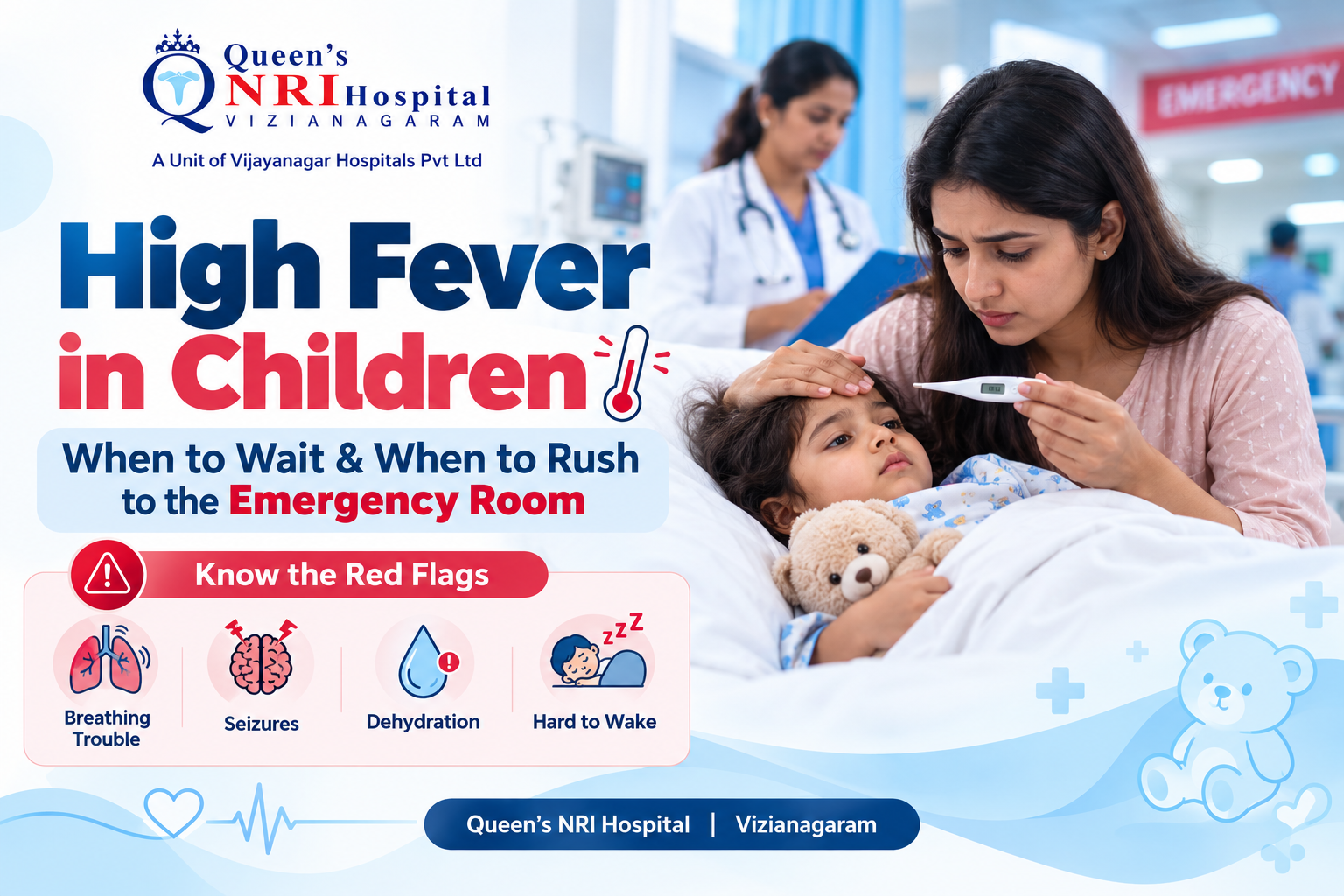
It is 2 a.m. Your toddler feels hot to the touch. She is crying and cannot settle. You place your hand on her forehead, and your heart starts to race. Is this a normal fever, or is something serious going on?
Every parent has been in this spot. Fever is one of the top reasons families look for a Children Emergency Hospital in Vizianagaram. The good news is that fever is usually not the enemy. It is a sign that your child's body is fighting an infection.
Still, some fevers need quick medical care. This guide helps you tell the difference in simple words. You will learn when it is safe to wait at home, which warning signs mean you should rush to the emergency room, and what to do while you travel. Keep this page handy. It can help you stay calm when it matters most.
What Is Fever in Children?
Fever means your child's body temperature is higher than normal. The body raises its temperature on purpose. A warmer body helps fight germs such as viruses and bacteria.
A normal body temperature is about 98.6°F (37°C). It can go slightly up or down during the day. It is often lower in the morning and higher in the evening.
Doctors call it a fever when the temperature reaches 100.4°F (38°C) or above. A temperature of 102°F (39°C) or more is called a high fever. Anything near 104°F (40°C) needs urgent attention.
How to Measure Fever the Right Way
Touching the forehead is not enough. Your hand can easily guess wrong. Follow these simple steps:
- Use a digital thermometer. Avoid old glass thermometers, as they can break.
- Wait 20 to 30 minutes after a bath, heavy blankets or play before checking.
- For babies, ask your doctor or nurse to show you the safest method.
- Write down the reading and the time. Doctors find this very helpful.
Why Do Children Get High Fever?
Fever is a symptom, not a disease. It points to something happening inside the body. Common causes include:
- Viral infections: Colds and flu are the most common reasons. Most settle on their own with rest and fluids.
- Throat and ear infections: These cause pain, and the fever often rises in the evening.
- Urinary tract infection (UTI): An infection in the urine passage. It can cause fever without any cold or cough.
- Monsoon illnesses: The rainy season brings more mosquitoes and unclean water. Dengue, typhoid and malaria become more common. These can cause high fever and need a doctor's check.
- After vaccines: A mild fever for a day or two is common and usually harmless.
The teething myth: Many families believe teething causes high fever. Teething may make a baby fussy and slightly warm. It does not cause a true high fever. If your baby has a real fever, look for another cause and speak to a doctor.
When You Can Wait and Care at Home
Not every fever means a hospital visit. Many children get better at home. Here is a real-life example.
Four-year-old Ravi has a fever of 101°F. He is tired, but he plays for a while, drinks water and eats a little. He passes urine as usual.
Ravi is likely safe to care for at home while you watch him closely. These are good signs:
- Your child is alert and responds to you
- Your child is drinking fluids
- Your child is passing urine normally
- Your child's mood improves when the fever comes down
Simple Home Care Tips
- Give plenty of fluids. Water, ORS, soup, coconut water and breast milk for babies all help.
- Let your child rest. There is no need to force activity.
- Dress your child lightly. Thin cotton clothes let heat escape.
- Use a lukewarm sponge. Gently wipe the body with a cloth dipped in room-temperature water.
- Give medicine only as advised by your child's doctor. Never guess the amount.
Keep checking your child every few hours, even at night. A child who looks fine in the afternoon can change by evening.
Red Flag Signs: When to Rush to the Emergency Room
Trust your instincts. You know your child best. If something feels wrong, go. These signs mean your child needs a Children Emergency Hospital in Vizianagaram without delay:
- A baby under 3 months with a temperature of 100.4°F (38°C) or above. Very young babies cannot fight infection well, so every fever is urgent.
- Fever lasting more than 3 days. Something may need testing and treatment.
- Temperature of 104°F (40°C) or higher.
- Difficulty breathing or fast breathing. Look for a sucking-in of the belly or chest with each breath, or flaring nostrils.
- Seizures (fits). Shaking, stiffening or staring with no response.
- Stiff neck, severe headache or dislike of bright light.
- A rash that does not fade when pressed. Press a clear glass on the spot. If the rash stays visible, go quickly.
- Very sleepy, hard to wake or unusually weak. A child who does not respond normally is a concern.
- Signs of dehydration (lack of body water): no urine for 8 hours, dry mouth, no tears when crying, or sunken eyes.
- Repeated vomiting or being unable to drink.
- Severe pain in the belly, ear or throat.
Remember: how your child looks and behaves matters as much as the number on the thermometer. A child with 103°F who is playful may be less worrying than a child with 101°F who is limp and quiet.
Fever Guide by Age
Age changes how quickly you should act. Use this simple table as a guide.
|
Age |
Fever Level |
What to Do |
|
Newborn to 3 months |
100.4°F (38°C) or above |
Go to the emergency room right away |
|
3 to 12 months |
102°F (39°C) or above, or any fever with poor feeding or sleepiness |
Call your doctor today. Go to the emergency room if your baby looks unwell |
|
1 to 5 years |
102°F (39°C) or above, or fever lasting more than 3 days |
See a doctor. Go to the emergency room if you see any red flag sign |
|
5 to 12 years |
103°F (39.4°C) or above, or fever lasting more than 3 days |
See a doctor. Go to the emergency room for breathing trouble, severe headache or confusion |
Febrile Seizures: What Parents Should Do
Sometimes a fast-rising fever causes a seizure (fit) in a young child. This is called a febrile seizure. It usually happens between 6 months and 5 years of age. It looks scary, but most febrile seizures stop on their own and do not cause lasting harm.
If it happens, follow these steps:
- Stay calm. Your calm voice helps both of you.
- Lay your child on their side on a soft, safe surface. This keeps the airway clear.
- Do not put anything in the mouth. No spoon, finger, water or food.
- Loosen tight clothing around the neck.
- Note the time. Count how long the seizure lasts.
- Do not hold your child down.
- Go to the hospital after the seizure, even if your child seems fine. If it lasts more than 5 minutes, call for emergency help immediately.
Common Mistakes Parents Make
Even loving parents make mistakes when they are worried. Avoid these:
- Giving the wrong amount of medicine. Too much can harm your child. Always follow your doctor's advice.
- Using cold water or ice baths. This can make your child shiver, which may raise the temperature. Use only lukewarm sponging.
- Wrapping the child in thick blankets. Heat gets trapped. A fever needs light clothing.
- Giving antibiotics without a doctor's advice. Most fevers come from viruses, and antibiotics do not work on them. Wrong use can cause harm and make future treatment harder.
- Waiting too long. Many parents say, "Let us see in the morning." If a red flag sign is present, do not wait.
- Mixing home remedies with medicines without asking a doctor first.
What Happens at a Children's Emergency Hospital
Fear of the unknown makes a hospital visit harder. Knowing what to expect can help you and your child stay calm.
- Quick check-in: The team first checks how serious your child's condition is. The sickest children are seen first.
- Examination: The doctor checks temperature, breathing, heartbeat, throat, ears, skin and belly.
- Tests, if needed: These may include blood tests, urine tests or a chest X-ray. Not every child needs them.
- Treatment: This may include medicine to bring the fever down, fluids through a drip for dehydration, or treatment for the infection.
- Observation: Your child may be watched for some hours to see how they respond.
- Clear advice: The doctor explains what is wrong, what to do at home and when to return.
You are welcome to stay with your child and ask any question. Good doctors are happy to explain.
Why Choose a Children Emergency Hospital in Vizianagaram
Children are not small adults. Their bodies react differently to illness and can change quickly. That is why a hospital that understands child emergencies makes a real difference.
Here is what to look for:
- Doctors who treat children every day: They know the signs that matter in small patients.
- Quick response: In fever with seizures or breathing trouble, minutes count.
- Readiness at all hours: Children often fall ill at night, so round-the-clock emergency care is important.
- Child-friendly care: Gentle staff and a calm setting help children feel safe.
- Close to home: A hospital in your own town saves precious travel time.
At Queen's NRI Hospital in Vizianagaram, our team understands how stressful a child's fever can be for parents. Families from Vizianagaram, Rajam, Bobbili and nearby towns can reach us for urgent child care and guidance.
Quick Summary
|
You Can Wait and Watch at Home |
Rush to the Emergency Room |
|
Child is playful and alert |
Baby under 3 months with any fever |
|
Child is drinking fluids |
Fever above 104°F (40°C) |
|
Passing urine normally |
Fever for more than 3 days |
|
Fever below 102°F (39°C) |
Fits or seizures |
|
Fever eases with rest and light clothing |
Fast or difficult breathing |
|
Child looks better when fever drops |
Stiff neck or severe headache |
|
No other worrying signs |
Rash that does not fade, extreme sleepiness or dehydration |
Frequently Asked Questions
What temperature is dangerous for a child?
A temperature of 104°F (40°C) or higher needs urgent care. For babies under 3 months, even 100.4°F (38°C) is serious. Your child's behavior matters as much as the number.
Can I give paracetamol to my child at home?
Paracetamol is commonly used for fever, but the amount depends on your child's weight and age. Give it only as advised by your child's doctor.
How long should a child's fever last?
Most viral fevers settle within 2 to 3 days. If the fever lasts longer than 3 days, see a doctor.
Should I take my baby to the hospital for a mild fever?
For a baby under 3 months, yes, always. For older babies, call your doctor. Go to the hospital if your baby is not feeding, is unusually sleepy or looks unwell.
Is fever with cold hands and feet an emergency?
It can be. Cold hands and feet with fever, pale or blotchy skin and extreme tiredness may signal a serious infection. Take your child to the emergency room right away.
Conclusion
Fever frightens parents, but understanding it makes it easier to handle. Most fevers are your child's body doing its job. Plenty of fluids, rest and careful watching are often enough. Yet some signs, such as fits, breathing trouble, a very young baby with fever, or a child who is hard to wake, mean you should not wait.
Keep this guide in mind, and trust your instincts. If you are unsure, take your child to the nearest Children Emergency Hospital in Vizianagaram. When in doubt, get your child checked. A quick visit can bring peace of mind, and in some cases, it can make all the difference.
.jpg)
.png)